
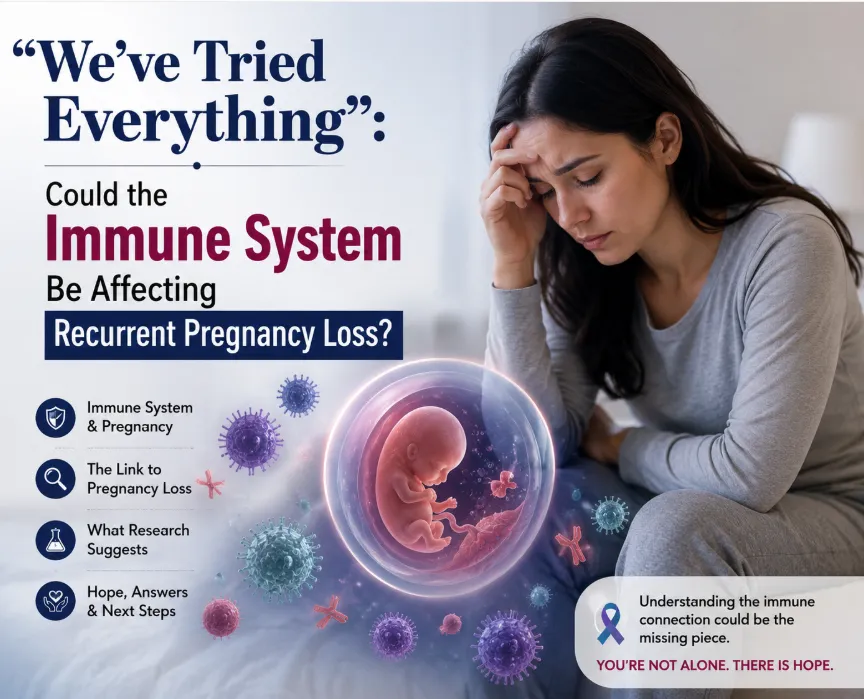

After the third miscarriage, Meera stopped saying, “Maybe next time.”
The optimism had faded.
Every report looked reassuring. Hormones? Normal. Scans? Fine. Embryos? Good quality. Yet somehow, every pregnancy ended the same way.
Friends suggested rest. The family suggested faith. The internet suggested supplements.
But eventually, during a fertility consultation, she heard a question nobody had asked before:
“Have we evaluated immune-related causes?”
Her response was immediate:
“The immune system? What does that have to do with pregnancy?”
For many couples experiencing recurrent pregnancy loss (RPL), this topic feels unfamiliar.
And understandably so.
Basic fertility conversations usually focus on:
● Hormones
● Egg quality
● Sperm health
● Uterine structure
● IVF procedures
But sometimes, when couples say:
“We’ve tried everything.”
Doctors begin exploring something deeper:
Could the body’s immune response be affecting implantation or pregnancy stability?
It is a complex area of reproductive medicine.
And one that deserves careful, science-backed discussion – without fear or false promises.
First: What Is Recurrent Pregnancy Loss?
Recurrent pregnancy loss generally refers to two or more consecutive miscarriages, though definitions can vary medically.
For many couples, the emotional experience is devastating.
The hardest part?
Pregnancy keeps happening.
But it does not continue.
That uncertainty can feel emotionally brutal because hope appears – and disappears – repeatedly.
Causes of recurrent miscarriage may include:
● Chromosomal abnormalities
● Hormonal imbalance
● Uterine abnormalities
● Blood clotting disorders
● Thyroid dysfunction
● Age-related egg quality changes
● Lifestyle or medical factors
And in selected cases:
Immune system dysfunction.
This is where conversations become more advanced.
Can the Body Really “Reject” an Embryo?
This phrase is commonly used – but medically, it needs nuance.
The immune system is designed to protect the body.
Normally, it identifies foreign threats such as viruses or infections.
But pregnancy creates a fascinating biological challenge.
An embryo contains genetic material from both parents, meaning part of it is biologically different from the mother.
Yet most pregnancies succeed because the immune system adapts.
It shifts into a carefully balanced state that supports implantation and fetal growth.
In some cases, however, researchers believe this balance may not function normally.
The result?
Inflammation or immune overactivity that may interfere with:
● Implantation
● Placental development
● Pregnancy progression
Importantly:
This does not mean the body is consciously “rejecting” pregnancy.
Science is far more complicated than that.
But immune-related reproductive issues are increasingly being studied in fertility medicine.
The Hidden Role of Reproductive Immunology
Reproductive immunology looks at how the immune system interacts with fertility and pregnancy.
Some areas doctors may evaluate in recurrent pregnancy loss include:
1. Autoimmune Conditions
Sometimes, the immune system mistakenly attacks healthy tissue.
Conditions such as:
● Autoimmune thyroid disease
● Lupus
● Antiphospholipid syndrome (APS)
have been linked to miscarriage risk in some patients.
APS, in particular, may increase abnormal blood clotting that affects placental blood flow.
The encouraging part?
Some immune-related causes are medically manageable once identified.
2. Excessive Inflammatory Response
Pregnancy depends on a carefully regulated inflammatory environment.
Too much immune activation may potentially interfere with implantation or placental growth.
This area remains scientifically complex and actively researched.
Not every clinic evaluates immune markers routinely because evidence varies across conditions.
That is important to understand.
3. Natural Killer (NK) Cells – The Controversial Conversation
If you have searched online about recurrent miscarriage, you have probably encountered discussions about Natural Killer (NK) cells.
These immune cells naturally help defend the body.
Some theories suggest abnormal immune activity involving NK cells could influence implantation or miscarriage risk.
But here is where responsible medical discussion matters:
The science remains debated.
Some fertility specialists investigate immune factors more extensively than others.
And not every immune test automatically changes treatment outcomes.
Good fertility care avoids overpromising.
Because reproductive immunology is still evolving.
Why This Topic Is Rarely Discussed in Basic Fertility Blogs
Simple fertility advice is easier.
“Track ovulation.”
“Improve diet.”
“Reduce stress.”
But couples with recurrent pregnancy loss often need deeper answers.
Especially when standard testing shows:
Everything looks normal.
This is often called unexplained recurrent miscarriage – one of the most emotionally exhausting diagnoses because there are no obvious explanations.
At a trusted fertility hospital in Chennai, specialists may sometimes recommend more detailed investigation after repeated pregnancy losses to better understand whether immune, hormonal, anatomical, or genetic factors are contributing.
Because repeated miscarriage deserves deeper evaluation – not dismissal.
The Emotional Cost of “Trying Again”
One of the hardest realities of recurrent pregnancy loss is fear.
After enough losses, pregnancy itself becomes emotionally frightening.
Couples stop celebrating positive tests.
Hope feels dangerous.
Many quietly wonder:
“What if my body just can’t hold a pregnancy?”
That fear is understandable.
But repeated miscarriage does not automatically mean parenthood is impossible.
In many cases, identifying the underlying issue – whether hormonal, clotting-related, anatomical, or immune-related can significantly improve planning and treatment decisions.
The important thing is not assuming failure.
It is asking better questions.
Why Self-Diagnosing Online Can Be Risky
Immune infertility discussions online can quickly become overwhelming.
Patients encounter:
● Experimental treatments
● Expensive immune panels
● Conflicting opinions
● Fear-based information
The truth?
Not every miscarriage is immune-related.
And not every immune finding explains pregnancy loss.
Responsible fertility care involves evidence-based investigation – not chasing every internet theory.
That distinction matters.
At leading fertility hospital, fertility teams increasingly focus on personalised care pathways because recurrent pregnancy loss is rarely caused by one single factor alone.
Sometimes, answers lie in genetics.
Sometimes hormones.
Sometimes uterine health.
And occasionally, the immune system becomes part of the conversation.
Final Thought
When couples say:
“We’ve tried everything.”
What they are often really saying is:
“We just want answers.”
Recurrent pregnancy loss is emotionally devastating precisely because it creates uncertainty.
And while immune-related causes remain a complex and evolving field, they remind us of something important:
Pregnancy is not just about fertilisation.
It is about what happens after implantation too.
For couples facing repeated loss, deeper evaluation can sometimes uncover answers hidden beneath seemingly “normal” reports.
Because sometimes, fertility struggles are not about trying harder.
They are about understanding the body more clearly.