
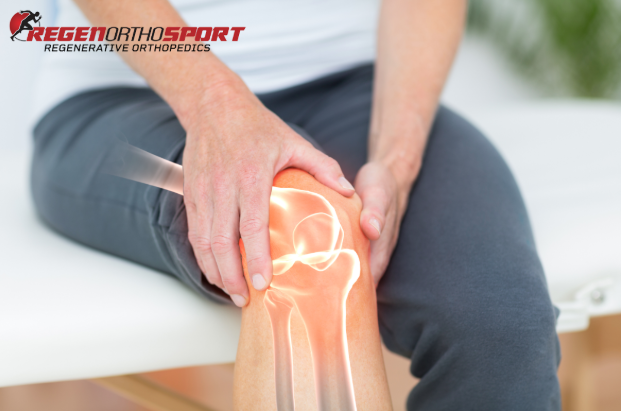

People of all ages suffer from knee discomfort, which is one of the main reasons for limited mobility and a lower quality of life. Even the most basic everyday tasks, including walking, sitting, climbing stairs, or exercising, can be hampered by knee discomfort, from young sportsmen ligament injuries to middle-aged people dealing with meniscus tears and elderly people suffering from arthritis-related degeneration.
At RegenOrthoSport, we use regenerative treatments to improve long-term function, lower inflammation, and restore joint health in a completely innovative non-surgical approach to knee discomfort. We provide cutting-edge non-surgical orthopedic treatments like PRP therapy, stem cell treatment, and BMAC to address the underlying cause of pain under the skilled supervision of Dr. Venkatesh Movva. ACL tears, meniscus damage, ligament injuries, and arthritis are all successfully treated by regenerative treatments.
Knowing the Knee Joint and the Causes of Pain
The knee is a sophisticated, high-load joint that enables smooth movement, stability, and shock absorption. It depends on the health of the surrounding muscles, meniscus, cartilage, ligaments, and synovial fluid. Pain, edema, and instability may occur if any of these structures sustain damage or start to deteriorate.
The following are typical causes of knee pain:
- Early osteoarthritis and cartilage degradation
- ACL, MCL, or PCL strains are examples of ligament injuries.
- Meniscus tears brought on by repetitive strain or twisting
- Overuse injuries in sports
- Unbalanced muscles or poor joint mechanics
- Inflammation following an injury that does not fully heal
These problems may develop into persistent knee discomfort and long-term functional impairments if prompt action is not taken.
Different Types of Knee Pain and What They Indicate
Understanding the pattern of knee pain is necessary for selecting the proper regeneration treatment.
- Pain can be caused by walking, crouching, or ascending stairs, and it is often the result of ligament overuse, meniscus injury, or cartilage loss.
- The inability of the knee to bear weight typically suggests ligament involvement and may demand focused therapy for an ACL tear.
- Inflammatory and arthritic knee problems are typically characterized by chronic edema, warmth, and stiffness, especially in the morning.
- If left untreated, these symptoms, which generally indicate meniscus damage, may worsen.
Constraints of Traditional Knee Pain Management
Instead of restoring joint health, traditional knee therapy frequently tries to reduce symptoms.
Typical Problems with Conventional Therapies:
- Damaged tissues cannot be repaired by painkillers.
- Over time, steroid injections may cause cartilage to deteriorate.
- Repeated injections become less effective.
- Instead of regenerating tissue, arthroscopy eliminates it.
- Joint mechanics are permanently changed with knee replacement.
These methods slow down, but do not stop, the progressive degradation of joints in many individuals.
A Transition to Real Knee Healing with Regenerative Medicine
Regenerative therapy repairs damaged tissues and reestablishes joint harmony by utilizing the body’s own healing processes.
Goals of Knee Regenerative Therapy:
- Reduce persistent inflammation
- Encourage meniscus, ligament, and cartilage repair
- Boost stress absorption and joint lubrication
- Regain mobility and stability.
- Maintain the natural knee joint.
This strategy offers regenerative medicine a potent choice for people looking for long-term, non-surgical knee pain relief.
PRP Therapy for Knee Pain
A concentrated form of your own platelets, which are rich in growth factors necessary for tissue regeneration.
How PRP Helps in Knee Repair:
- Speeds up the healing of ligaments and cartilage.
- Lowers the joint’s inflammatory substances
- Improves meniscus tissue healing
- Increases the flexibility and lubrication of joints
- Aids in the healing of sports and overuse injuries
Ideal candidates: Those with meniscus injuries, ligament strains, early-stage arthritis, and those looking for conservative knee pain treatment are the best candidates.
Healing Timeline: Improvement in symptoms usually starts in four to six weeks and lasts for two to three months.
Stem Cells therapy
By promoting tissue regeneration and immunological regulation, stem cell therapy for knee pain targets more advanced deterioration.
Benefits of Therapy:
- Promotes the renewal of cartilage
- Decreases the signaling of inflammatory joints
- Helps in meniscus and ligament repair
- Enhances the quality of movement and joint cushioning
- Reduces the rate at which degenerative arthritis advances
Perfect for: Patients with moderate arthritis, persistent knee discomfort, or those who have not received enough relief from PRP or traditional injections.
Healing Timeline: Sustained functional improvements over a period of three to six months.
BMAC Therapy
The highest concentration of regenerating cells in non-surgical care is provided by Bone Marrow Aspirate Concentrate (BMAC).
The Reasons BMAC Works So Well for Knee Pain:
- The most abundant source of growth factors and stem cells
- Treats the meniscus, ligaments, and cartilage all at once.
- Treats complicated or multi-structural knee injuries
- Longer-lasting relief compared to PRP alone
- Helps in postponing or preventing knee replacement surgery
Perfect for: Patients with significant meniscus tears, advanced arthritis, ligament degradation, and those looking for a complete regenerative therapy are the best candidates.
Healing Timeline: Benefits last for at least 18 to 36 months, with pain alleviation starting around 6 to 8 weeks and reaching its peak over 6 to 12 months.
Treatment for ACL Ligament Tears Without Surgery
Regenerative therapy frequently works successfully for partial ACL injuries and ligament degradation.
The goals of regenerative ACL therapy are:
- Strengthen injured ligament fibers
- Decrease joint instability and inflammation
- Boost your neuromuscular control
- Encourage a safe return to regular activities and sports
This method works particularly well for patients who want to avoid surgical reconstruction and partial rips.
Benefits of Treating Knee Pain Without Surgery
- Maintains the normal architecture of joints
- Prevents hospital stays and surgical risks
- Faster healing and less downtime
- More affordable than surgery
- Repeatable if necessary
Why Treat Knee Pain with RegenOrthoSport?
Expert-Led Regenerative Care: Under the guidance of Dr. Venkatesh Movva, expertise in non-surgical orthopedic and sports medical treatments.
Precision-Guided Injections: To ensure accurate, targeted administration for better outcomes, fluoroscopy and ultrasonography are used.
Customized Treatment Plans: Tailored to joint condition, lifestyle, and goals
Integrated Physical Therapy & Nutrition Support: Using evidence-based physical therapy and dietary recommendations to improve joint strength and healing.
Proceeding with Self-Assurance and Mobility
Knee discomfort doesn’t have to result in permanent pharmaceutical dependence or surgery. Regenerative medicine offers a potent alternative for treating knee pain that encourages healing, restores function, and safeguards the joint going forward.
At RegenOrthoSport, we can precisely and carefully treat meniscus tears, ligament injuries, and arthritis thanks to our proficiency in PRP therapy, stem cell therapy, and BMAC for knee pain.
Regenerative therapy might be the solution you need to address your knee pain effectively without surgery so you can proceed with confidence, strength, and stability.