

Meta Description: Compare 304 and 316 stainless steel sheets. Discover the critical chemical differences—like Molybdenum additions—corrosion resistance in marine and chemical environments, mechanical properties, and smart cost-selection strategies.
Target Keywords: 304 vs 316 stainless steel sheet, molybdenum stainless steel, marine grade stainless steel sheet, 316 corrosion resistance, austenitic stainless steel grades
Austenitic stainless steels—primarily AISI 304 and AISI 316—account for the vast majority of stainless steel sheets fabricated worldwide. While both grades share similar visual appearances and cold-forming capabilities, their performance differs dramatically in aggressive, chemical, or marine environments.
Selecting between 304 and 316 comes down to evaluating environmental severity, service life expectations, and upfront raw material costs.
1. Chemical Composition & The Role of Molybdenum
The foundational difference between Grade 304 and Grade 316 lies in alloying elements. Grade 304 contains 18% chromium and 8% nickel (often referred to as 18/8 stainless steel). Grade 316 incorporates an additional 2% to 3% Molybdenum (Mo).
$$text{Grade 316} = text{Base Chromium-Nickel Matrix} + mathbf{2text{–}3% text{Molybdenum}}$$
+————————————————————————-+
| ALLOYING ELEMENT COMPARISON |
| |
| Grade 304: [ Chromium 18% ] [ Nickel 8% ] |
| Grade 316: [ Chromium 16% ] [ Nickel 10% ] + [ MOLY 2-3% ] <— |
+————————————————————————-+
Key Alloying Elements and Their Functions:
-
Chromium (Cr): Forms a passive, self-healing chromium-oxide ($text{Cr}_2text{O}_3$) film on the surface that prevents atmospheric oxidation and surface rust.
-
Nickel (Ni): Stabilizes the austenitic crystal structure, giving the metal excellent ductility, non-magnetic properties, and toughness across wide temperature ranges.
-
Molybdenum (Mo): Significantly boosts resistance to localized chloride pitting, crevice corrosion, and acidic chemical attack.
2. Corrosion Resistance: Pitting & Chloride Attack
While Grade 304 performs exceptionally well in freshwater, architectural framing, and domestic food processing environments, it is susceptible to pitting corrosion when exposed to chlorides (such as sea salt or deicing chemicals).
When chloride ions breach the passive oxide layer of Grade 304, microscopic pits form beneath the surface. These pits can rapidly penetrate the sheet thickness despite the rest of the sheet looking pristine.
$$text{PREN} = % text{Cr} + 3.3 times (% text{Mo}) + 16 times (% text{N})$$
The Pitting Resistance Equivalent Number (PREN) quantitatively predicts pitting resistance:
-
Grade 304 PREN: $approx 18.0 text{–} 20.0$
-
Grade 316 PREN: $approx 23.0 text{–} 25.0$
The higher PREN score of Grade 316 reflects its ability to prevent localized pit initiation in saltwater splash zones, coastal structures, and industrial chemical vats.
3. Mechanical & Thermal Comparison
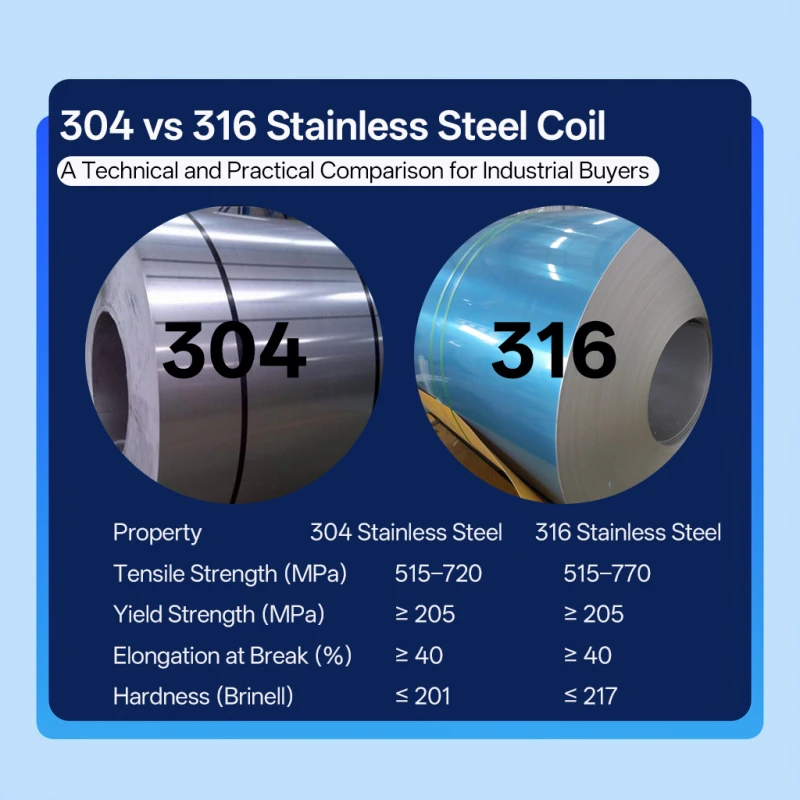
Both grades share similar yield strengths, tensile properties, and work-hardening rates. However, their structural behavior holds subtle differences under elevated temperature or extreme cold:
|
Mechanical / Thermal Property |
Grade 304 |
Grade 316 |
|
Tensile Strength (MPa) |
$515 text{–} 620$ |
$515 text{–} 620$ |
|
Yield Strength 0.2% (MPa) |
$205 text{–} 275$ |
$220 text{–} 290$ |
|
Elongation at Break (%) |
$40 text{–} 60$ |
$40 text{–} 60$ |
|
Density ($text{g/cm}^3$) |
$7.93$ |
$8.00$ |
|
Max Service Temp (Intermittent) |
$870^circtext{C}$ |
$870^circtext{C}$ |
|
Max Service Temp (Continuous) |
$925^circtext{C}$ |
$925^circtext{C}$ |
4. Cost Trade-Offs & Application Matrix
Because Nickel and Molybdenum are high-cost commodities subject to global market fluctuations, Grade 316 sheets carry a 20% to 40% price premium over Grade 304.
Over-specifying Grade 316 for benign indoor environments adds unnecessary material expense, while under-specifying Grade 304 in marine environments leads to premature structural failure and high replacement costs.
ENVIRONMENTAL SEVERITY vs GRADE SELECTION
Low Exposure High Exposure
Indoor / Mild Outdoor Coastal / Chemical
<————————————————————————->
GRADE 304 GRADE 316
• Commercial kitchens • Marine fittings
• Wall cladding & trims • Coastal architectural facades
• Water tanks & sinks • Pharmaceutical equipment
• Automotive trim • Chemical processing vessels
5. Low-Carbon Variants: 304L vs. 316L
When heavy welding of stainless steel sheets is required, standard 304 and 316 grades can experience sensitization—where chromium carbide precipitates along grain boundaries at temperatures between $450^circtext{C}$ and $850^circtext{C}$, lowering localized corrosion resistance.
To prevent this:
-
304L & 316L (Low Carbon): Carbon levels are restricted to a maximum of 0.03% (down from $0.08%$). This prevents carbide precipitation during welding, preserving full corrosion resistance in welded joints without requiring post-weld heat treatment.
Summary: Grade 304 is the cost-effective industry default for non-marine, low-chloride applications like food service, indoor fixtures, and general fabrication. Grade 316 is the mandatory choice whenever materials face marine air, direct saltwater splash, deicing salts, or aggressive chemical processing environments.